

A Comprehensive History of the U.S. Nickel
A Comprehensive History of the U.S. Nickel
The five-cent coin, commonly known as the nickel, has undergone remarkable transformations since the earliest days of the United States Mint. From its origins in precious metal to its emergence as a durable workhorse of everyday commerce, the nickel reflects shifting economic realities, advancing minting technology, and changing artistic priorities.
Tracing the history of the nickel’s evolution offers collectors more than a timeline of designs, it reveals how America adapted its coinage to meet the needs of a growing nation while preserving symbolism and artistry.
The Origin of the Nickel: From Half Dime & Three-Cent Nickel to Five-Cent Nickel
America’s first five-cent piece wasn’t a nickel at all. Beginning in the early 1790s, the U.S. Mint struck the silver half dime, a small but valuable coin that served early commerce during the nation’s formative years.
The Three-Cent Nickel: A Short-Lived but Important Experiment
As the United States transitioned away from precious metal coinage during the Civil War, the Mint experimented with alternative denominations to ease the nationwide shortage of small change. One of the most unusual outcomes was the three-cent nickel, first authorized in 1865.
Struck from the same copper-nickel alloy later used for the five-cent piece, the three-cent nickel was designed to replace the unpopular silver three-cent coin, which had become impractical in circulation. Its distinctive design featuring a Roman numeral “III” encased within a wreath made it instantly recognizable, though its small size and unconventional denomination limited public enthusiasm.
While the three-cent nickel never achieved widespread popularity, it played a crucial role in proving the viability of copper-nickel alloys for everyday use. The success of that alloy directly influenced Congress’ decision to authorize the five-cent nickel just one year later.
Production of the three-cent nickel ended in 1889, but its legacy lives on as a transitional coin, a bridge between silver-based denominations and the durable base-metal coinage that defines modern nickels and other coins in U.S. circulation. For collectors, it represents an important chapter in the Mint’s adaptation to economic pressure and innovation.
Major Design Eras of the U.S. Nickel
Shield Nickel (1866–1883)
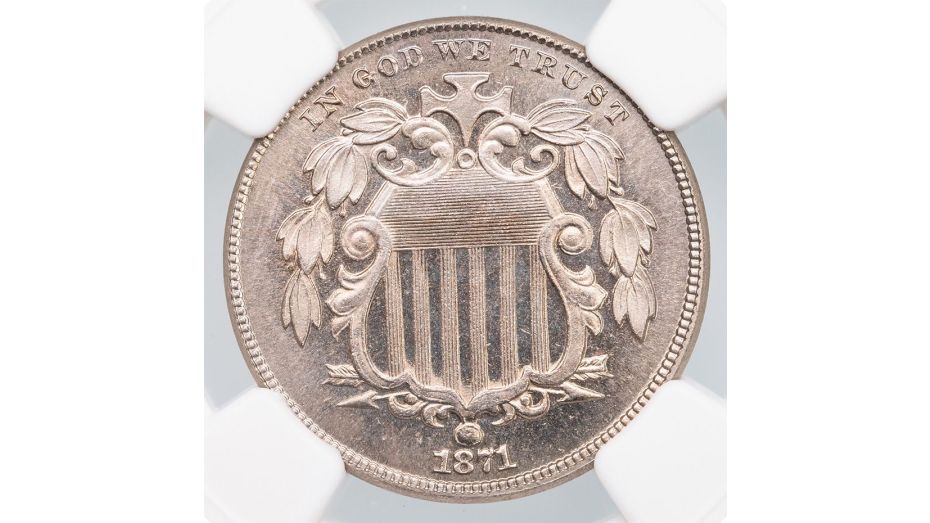
The Shield Nickel was America’s first true nickel coin, introduced in 1866 as the first nickel produced by the U.S. Mint. Its obverse featured a bold union shield motif on the obverse symbolizing unity and strength following the Civil War, while the reverse displayed a prominent “5 CENTS” to clearly denote its value.
The hard copper-nickel alloy proved difficult to strike, leading to early coin production challenges and frequent die wear. As a result, the rays between the stars on the reverse were removed in 1867 to simplify striking. Despite these obstacles, the Shield Nickel established the five-cent piece as a permanent fixture in U.S. coinage.
Liberty Head “V” Nickel (1883–1913)
In 1883, the Shield design gave way to the elegant Liberty Head Nickel, featuring a classical portrait of Liberty on the obverse and a Roman numeral “V” on the reverse. The first version of the 1883 Liberty Head famously omitted the words “FIVE CENTS,” which allowed unscrupulous individuals to gold-plate the coins and pass them off as five-dollar pieces, a scheme linked to a con man named Josh Tatum. The Mint quickly corrected the issue later that same year by adding the denomination in text, a change that created one of the most talked-about varieties in American numismatics.
Buffalo Nickel (1913–1938)
Few U.S. coins are as iconic as the Buffalo Nickel. Introduced in 1913 and designed by renowned sculptor James Earle Fraser, during the Renaissance of American Coinage, it featured a powerful Native American portrait on the obverse and a massive American bison on the reverse. Two uniquely American motifs, making it one of the most distinguishable U.S. coins ever produced.
This design represented a dramatic shift toward artistic, theme-driven coinage and celebrated the nation’s frontier heritage. While stunning, the details wore quickly in circulation, making high-grade examples especially desirable today.
Jefferson Nickel and Later Modifications (1938–Present)
In 1938, the Mint introduced the Jefferson Nickel, honoring Thomas Jefferson on the obverse and his historic Virginia estate, Monticello, on the reverse. This design would become the longest-running motif in nickel history.
The series evolved over time, most notably during 2004 – 2005, when special reverses featuring the Keelboat were struck to commemorate the Lewis and Clark expedition and Louisiana Purchase. In 2006, the Mint unveiled a forward-facing Jefferson portrait and returned Monticello to the reverse, blending tradition with a refreshed modern aesthetic.
Why the Nickel Matters and What It Reflects
The nickel’s many transformations mirror broader trends in American history, including economic shifts, wartime necessity, artistic movements, and technological innovation at the Mint.
More than spare change, the nickel has served as both a practical tool of commerce and a miniature canvas for national symbolism. Each design era captures a moment in time, making the five-cent piece an accessible yet deeply meaningful denomination for collectors.
Understanding the nickel’s story allows enthusiasts to appreciate not just the coin itself, but the heritage it carries.
Explore Nickel History with RCTV
From the silver half dime to the rugged copper-nickel alloy, from the bold Buffalo Nickel to the enduring Jefferson Nickel design, the history of America’s five-cent coin spans centuries of change and craftsmanship.
At Rare Collectibles TV, we present nickels that tell that story, each design era, each symbolic detail, each minting milestone brought to life through expertly curated offerings.
Explore our nickel collection and experience firsthand the historical depth, artistic imagination, and lasting legacy of one of America’s most enduring coins.


